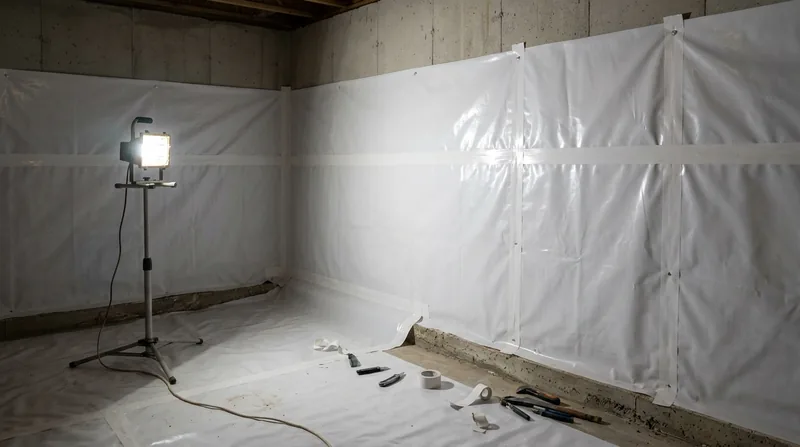




Coram sits in the middle of Suffolk County, where sandy glacial soils meet denser layers that trap water, and the water table climbs toward the South Shore bays. That means the lower level of a 1950s Cape or a 1980s Colonial off Route 112 can feel damp even when no crack is visible. Vapor Barrier Installation in Coram targets that invisible problem: ground moisture vapor pushing through block and poured concrete walls and the slab. We install heavy-duty barrier sheets with sealed seams and taped terminations, so humid Long Island summers stop feeding mustiness into the basement. If you have already spotted efflorescence or a musty smell, start with a free basement inspection before you spend a dollar on materials.
Why Coram Basements Sweat: Block Walls, Sandy Soil and Long Island Humidity
Most Coram housing stock was built between the 1950s and the 2000s, and the block foundations under those Capes, ranches and hi-ranches pull moisture straight out of the surrounding soil. The vapor moves through the mortar joints and the porous block, then condenses on the cooler interior face. That is why a basement can read dry on a humid July afternoon and still smell like a wet dog by August.
- Glacial sandy soils drain fast at the surface but hold vapor against the foundation wall.
- Denser soil layers trap water and push it sideways under slab-on-grade floors.
- Nor'easters and record cloudbursts like the August 2014 Islip storm drive water against the footing, raising hydrostatic pressure.
- Freeze-thaw cycles open hairline cracks that let vapor through even when liquid water stays out.
- Oak and pitch pine roots near the foundation shift soil and change how surface water drains.
A vapor barrier is not a substitute for drainage, but it closes the last gap that drainage alone leaves open.
Key info: On a 1962 block-foundation ranch in Coram, we have pulled back paneling to find efflorescence halfway up the wall with no visible crack. That is vapor drive, not a leak, and a sealed barrier is the correct fix.
For official guidance on basement moisture and foundation work, the U.S. Department of Housing and Urban Development publishes homeowner resources, and your local building department confirms what permits apply before any wall is opened.
How We Install a Vapor Barrier in a Coram Basement
We do not staple plastic to a wall and call it done. The prep work decides whether the barrier holds for a decade or peels off in two summers. On poured-concrete basements in the newer Coram townhouse communities, the sequence is tighter than on an old block wall, so we adjust the method to the wall type before we cut a single sheet.
- We inspect the wall for active seepage, efflorescence and bowing, and we note any crack that needs foundation crack repair first.
- We scrape and wire-brush the wall, then parge rough block so the barrier sits flat.
- We fasten heavy-duty barrier sheets with mechanical terminations at the top plate and the footing.
- We seal every seam with barrier tape and overlap the sheets by the manufacturer's specified width.
- We tape the slab termination and integrate the barrier with the sump basin where a pump is present.
- We leave a service gap around the sump lid and discharge line so the pump stays accessible.
Every termination gets a mechanical fastener plus sealant, because tape alone fails on a damp wall.
Key info: A finished basement in Miller Place had drywall tight to the block. We pulled the bottom two feet, installed the barrier with a sealed slab termination, and tied it into the existing sump pump installation so the wall could dry behind the finish.
Vapor Barrier Methods We Use in Coram and When Each One Fits
Not every basement needs the same sheet or the same attachment. The table below shows the approaches we actually install across Coram, Selden and Centereach, and the condition each one solves.
| Approach | Description | Best for |
|---|---|---|
| Wall sheet barrier | Heavy-duty sheet fastened to the block or poured wall with sealed seams and taped top and bottom terminations. | Damp block walls in 1950s to 1970s Capes and ranches. |
| Dimple board drainage mat | Dimpled membrane that holds the barrier off the wall and lets vapor drain down to the footing. | Walls with active seepage where an interior drain tile system is also planned. |
| Slab vapor barrier | Sheet laid and taped across the floor, lapped into the wall barrier at the cove joint. | Slab-on-grade floors that sweat in humid summers. |
| Sump-integrated barrier | Wall and slab barrier tied into the sump basin with a sealed service gap around the lid. | Basements with an existing sump pump or a planned battery backup. |
| Finished-basement retrofit | Barrier installed behind new framing with a sealed bottom termination and vented cavity. | Newer Colonials in Ridge and Manorville with finished lower levels. |
We pick the method after we see the wall, not before, because the wrong sheet on a wet block wall traps moisture instead of stopping it.
Vapor Barrier Installation Cost in Coram: What to Expect
Most Coram vapor barrier work starts from $3 per square foot of wall and slab surface treated, and that figure moves with wall condition, height and access. A clean poured wall in a Medford Colonial is a different job from a rough block wall in a 1958 Cape with paneling to remove. The full breakdown lives on our pricing page; here is what actually drives the number.
- Wall condition: parging rough block and removing old paneling adds labor before the barrier goes up.
- Wall type: poured concrete is faster to prep than mortar-jointed block.
- Height and access: a hi-ranch with a low ceiling and tight stairs slows every sheet.
- Sump integration: tying the barrier into a basin and discharge line adds fittings and time.
- Moisture testing: we confirm whether hydrostatic pressure needs drainage first, which changes the scope.
Get two or three written estimates and compare scope line by line, because a low bid that skips parging or seam sealing is not the same job.
Hiring a Waterproofing Contractor Near Coram: What to Check Before You Sign
Vapor barrier work is only as good as the prep and the sealing, so the contractor matters more than the sheet. Ask for proof of licensing and insurance before anyone touches your wall, and get a certificate of insurance sent directly from the carrier. Call two recent references in Coram, Selden or Centereach and ask whether the basement stayed dry through a humid August and a nor'easter. Confirm in writing who pulls any permit, since work that alters drainage or the sump discharge connection can require one, and rules vary by jurisdiction. If you belong to a townhouse or HOA community, check the association rules on wall penetrations before the crew arrives.
We are a Basement Health Association member, and we will tell you plainly when a barrier is enough and when hydrostatic pressure means you need drainage first. Reach out through our contact page to schedule a look at your basement.
Vapor Barrier Installation in Coram: Pricing Guide
| Service | Price | Details |
|---|---|---|
| Wall vapor barrier installation | Starting at $3/sq ft | Includes wall prep, heavy-duty sheet, sealed seams and taped terminations; rough block adds labor. |
| Slab vapor barrier | Starting at $3/sq ft | Sheet laid and taped across the floor and lapped into the wall barrier at the cove joint. |
| Dimple board drainage mat | Starting at $4.50/sq ft | Dimpled membrane over the barrier where seepage is active and drainage must be added. |
| Sump-integrated barrier | On estimate | Tying the wall and slab barrier into the sump basin needs an on-site look at the lid and discharge line. |
| Free basement inspection | Free | Moisture check and written scope, response within 24 hours at (631) 830-0164, no obligation. |
Indicative pricing, the exact cost depends on square footage, finish, and site access. Free personalized estimate within 24h at (631) 830-0164.


