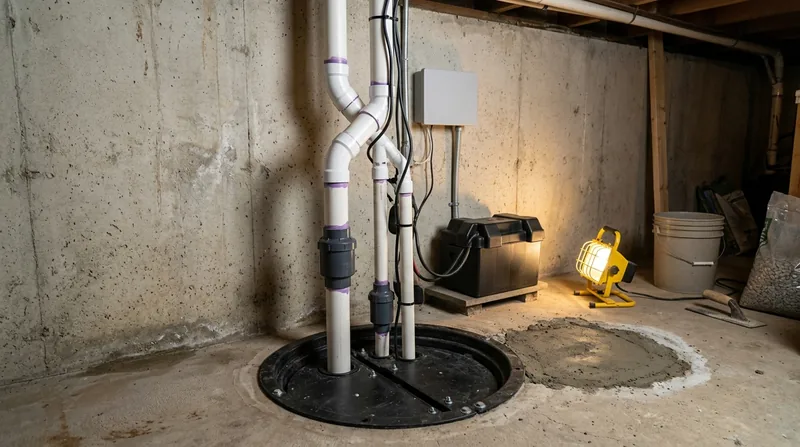




Battery Backup Sump Pumps in Coram: When the Power Drops, the Water Doesn't
Coram sits on the sandy glacial outwash that runs through the middle of Suffolk County, and that soil drains fast until it doesn't. A shallow water table near the low ground, denser layers that trap water, and the moraine slopes to the north all push groundwater toward the sump basin. Battery Backup Sump Pumps in Coram keep that basin pumped out when the grid fails, which is exactly when a nor'easter or a cloudburst like the August 2014 Islip storm overwhelms the drainage. We install and service backup systems sized to your pit, your pump, and your discharge line. If you want the full picture of what your basement is doing, start with a free basement inspection and we will tell you straight whether the backup is the missing piece or whether something bigger is going on. A primary pump that quits during a storm is the most common way a dry basement turns into a wet one overnight.
Why Coram Basements Need Backup Power, Not Just a Good Pump
Most of the housing stock here was built between the 1950s and the 1970s: Capes, ranches, hi-ranches and split-levels sitting on block basements. Those block walls and older drain tiles were never designed for the volume a modern storm delivers. Add the 1980s to 2000s Colonials and townhouse units with poured-concrete basements in Coram and Middle Island, and you have thousands of sump pits that depend on one electric pump and one utility feed. When the power goes out, the water does not stop rising. It just has nowhere to go.
- Nor'easters knock out power for hours or days, and the pump stops while the water table keeps climbing.
- Record cloudbursts dump inches in an hour, and a single pump cycling hard can trip a breaker or burn out.
- Snowmelt and freeze-thaw in late winter send a slow, steady flow into the basin that runs long after the storm.
- Older pumps in 1950s Capes and ranches fail quietly, and homeowners only find out when the basement is already wet.
A backup system is the difference between a pump that runs and a pump that quits at the worst possible moment.
Key info: During Sandy in 2012 and the 2014 Islip cloudburst, the failures we saw in Coram, Selden and Centereach were not cracked foundations. They were dead pumps and no backup power. The water came up through the drain tile and the pit overflowed.
The U.S. Department of Energy's guidance on standby and backup power is a useful primer on how these systems are rated: energy.gov standby generators. For sump discharge and local code questions, always confirm with the Town of Brookhaven building department, since rules vary and must be verified.
How We Size and Install a Backup System in Coram
We do not sell a box and walk away. We look at the pit, the primary pump, the check valve, the discharge line and the actual water volume your basement sees. A backup battery that is undersized for a hi-ranch in Centereach does nothing but delay the flood by an hour. We match the battery capacity to the pump draw and the run time you need, then test the whole setup under load before we leave.
- We inspect the sump basin, the primary pump and the check valve to confirm the pit can take a second pump.
- We measure the discharge line and confirm it carries the combined flow without backing up.
- We set the backup pump at the correct height above the primary so it only kicks in when needed.
- We wire the battery, charger and alarm, then run a live test to prove the switchover works.
- We walk you through the alarm and the maintenance schedule so you know what a healthy system sounds like.
If the primary pump is already on its last legs, we will say so and quote a sump pump installation or replacement alongside the backup rather than let you pay twice.
Key info: A finished basement in Miller Place or Ridge with a high water table needs more battery run time than an unfinished block basement in Port Jefferson Station. We size to the room, not to a catalog page.
Backup Options We Install: A Side-by-Side Look
Not every basement needs the same hardware. Here is how the common approaches compare on run time, cost and the kind of Coram home each one fits.
| Approach | Description | Best for |
|---|---|---|
| Battery backup pump | A 12V DC pump on a deep-cycle battery with a charger and alarm, tied into the existing pit. | Most Coram homes with a working primary pump and a standard basin. |
| Dual battery bank | Two batteries in parallel for longer run time during multi-day outages. | Finished basements and high-water-table lots in Miller Place and Ridge. |
| Combination primary and backup unit | One integrated unit with an AC primary and DC backup in a single housing. | Tight pits in 1950s Capes and ranches where space is limited. |
| Alarm and monitoring add-on | High-water float switch and audible alarm that signals before the pit overflows. | Any homeowner who wants warning instead of a surprise. |
We will tell you which row fits your pit after we see it, and we will not upsell a dual bank into a basement that does not need one.
Battery Backup Sump Pumps Cost in Coram: What to Expect
Pricing starts at $900 for a standard battery backup installation on an existing pit with a healthy primary pump. That figure covers the backup pump, battery, charger, alarm and the labor to set and test it. From there, the number moves with battery capacity, whether the discharge line needs reworking, and whether we are adding a second pump or a full combination unit. A finished basement in Mount Sinai that needs multi-day run time sits at the top of the range; a simple single-battery job in Selden sits near the bottom.
Getting two or three estimates is smart, and we encourage it. Ask each contractor what battery capacity they are quoting, how many hours of run time that buys, and whether the price includes the alarm and the test. A low number that omits the battery or the charger is not a real comparison. Our full pricing overview lays out the ranges so you can check any quote against it.
Battery Backup Sump Pumps Near Me: How to Vet a Contractor Near Coram
You are hiring someone to work inside your basement, on your electrical system, and around your foundation. That deserves a few direct questions before anyone touches the pit. A legitimate waterproofing specialist will answer all of them without hesitation.
- Confirm the contractor is licensed and insured, and ask for a certificate of insurance before work starts.
- Get at least two or three written estimates and compare the battery capacity and run time, not just the total.
- Ask for references from nearby jobs in Coram, Selden or Centereach and actually call one.
- Ask whether the work touches the sump discharge or the sanitary connection, since that can require a permit from the local building department.
- Ask what the alarm does and what maintenance the system needs, because a backup you never test is a backup you cannot count on.
If a quote sounds too good to be true, it usually is. Call us at (631) 830-0164 or use the contact page to set up a free, no-obligation estimate and we will give you a straight answer, even if that answer is that you do not need the work yet.
Battery Backup Sump Pumps in Coram: Pricing Guide
| Service | Price | Details |
|---|---|---|
| Standard battery backup installation | Starting at $900 | Includes backup pump, battery, charger, alarm, and full load test on an existing pit. |
| Dual battery bank upgrade | Starting at $1,450 | Adds a second battery for multi-day run time; price moves with capacity and wiring. |
| Combination primary and backup unit | Starting at $1,250 | Integrated AC and DC unit; cost rises if the discharge line needs reworking. |
| Complex or large-scale job | On estimate | Pits needing rework, new discharge routing, or finished-basement protection get an on-site look first. |
| Travel | Included | in Coram and surrounding areas, no separate call-out or mileage fee. |
| Estimate | Free | Response within 24h at (631) 830-0164, no obligation to book. |
Indicative pricing, the exact cost depends on square footage, finish, and site access. Free personalized estimate within 24h at (631) 830-0164.


