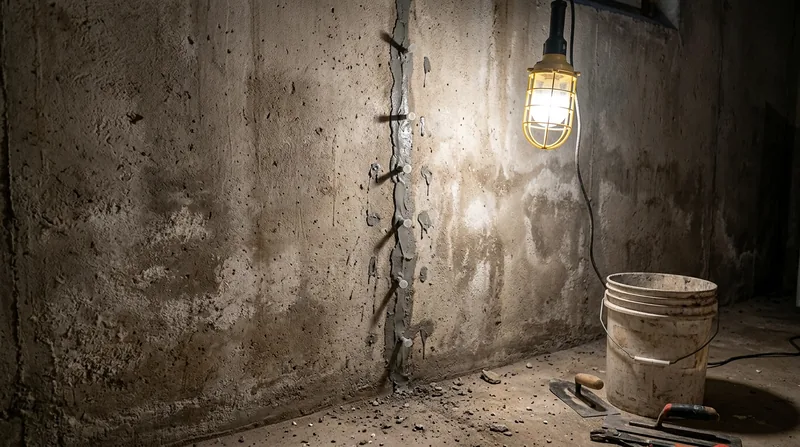




Foundation Crack Repair in Coram: Stop the Water Before It Spreads
Coram sits in the middle of Long Island, between the Harbor Hill moraine to the north and the sandy outwash plain that slopes toward the South Shore. That position matters to your basement. The glacial soils here hold sand, gravel, and denser clay layers that trap water, and when the water table rises after a nor'easter or a summer cloudburst, it pushes against your foundation. Foundation Crack Repair in Coram is the work of finding the crack that is letting that pressure through and sealing it correctly, whether the wall is a 1960s block basement on a ranch or a poured-concrete Colonial foundation from the 1990s.
We are a dedicated basement waterproofing specialist, not a general foundation firm and not a plumber. If a hairline crack is the whole problem, we inject it and tell you so. If the crack is a symptom of hydrostatic pressure that needs an interior drain tile system, we say that too. Call (631) 830-0164 to schedule a free basement inspection.
Why Cracks Open in Coram Basements and What They Tell You
Most cracks in Coram homes are not random. Block foundations on the older ranches and hi-ranches along the Middle Country Road corridor crack at the mortar joints when freeze-thaw cycles work the block, and poured walls in the 1980s and 2000s Colonials crack at the shrinkage line or where the backfill was not compacted. The August 2014 storm that dropped record rain on the area showed how fast sandy glacial soil can saturate and load a wall.
- Vertical cracks that appear within a year or two of construction are usually shrinkage cracks, and they are the easiest to inject.
- Stair-step cracks following the mortar joints in block walls point to settlement or frost movement, not just shrinkage.
- Horizontal cracks, especially with a wall that is bowing inward, mean the soil is pushing harder than the wall was built to resist.
- White powder on the wall (efflorescence) means water is moving through the concrete and evaporating on the inside face.
- A crack that only leaks after heavy rain is often tied to surface water and grading, not to a rising water table.
Each of those patterns calls for a different repair, which is why we inspect before we inject.
Key info: A homeowner in Selden called us about a damp spot on a block wall after every storm. The crack was a single stair-step joint, and polyurethane injection closed it in a few hours. A nearly identical-looking crack in a Medford split-level turned out to be a bowing wall that needed carbon fiber straps. Same symptom, different fix.
For questions about what your town requires before structural repair, start with the Town of Brookhaven building department, since permit thresholds vary by jurisdiction and must be verified locally.
How We Repair a Foundation Crack in Coram, Step by Step
We do not patch cracks one-size-fits-all. The first step is always an inspection that reads the crack, the wall, and the water behind it. From there we match the method to the failure, and we tell you plainly when simple sealing is enough and when the real answer is drainage.
- We walk the basement and the exterior, checking the crack width, the wall plumb, and the grading and downspout discharge on that side of the house.
- We drill injection ports along the crack at the spacing the crack demands, then flush the crack clean so the resin can bond to sound concrete.
- We inject epoxy for tight structural cracks that need to be bonded back together, or polyurethane for active leaks where the foam needs to expand and chase the water.
- We seal the surface, remove the ports, and check the repair under real water pressure before we call it done.
- If the inspection shows a bowing wall or a shifting crack, we move to structural options such as carbon fiber straps or wall anchors rather than injecting a wall that is still moving.
When the crack is only part of the story and water is coming up through the floor joint, the better answer is often an interior perimeter drain that takes the pressure off the wall instead of fighting it from the inside of the crack.
Key info: On a 1968 ranch in Coram, a vertical crack at the corner leaked every spring. The injection took under two hours, but the real fix was extending two downspouts that dumped water at the same corner. We did both in one visit and the wall has stayed dry through the last three nor'easters.
Crack Repair Methods We Use
The method follows the crack. Here is how the four main approaches compare on Coram walls.
| Approach | Description | Best for |
|---|---|---|
| Epoxy injection | Structural resin bonds the two faces of the crack back into one wall. | Tight, non-leaking vertical or shrinkage cracks in poured concrete. |
| Polyurethane injection | Foam expands on contact with water and seals active leaks. | Wet, seeping cracks and block wall joints that leak during storms. |
| Carbon fiber straps | Straps anchor the wall to the floor and stop inward movement. | Bowing walls with horizontal cracks that injection alone will not hold. |
| Wall anchors | Exterior plates and rods pull a moving wall back toward plumb. | Walls pushed in by saturated glacial clay and heavy backfill. |
| Surface sealing | Flexible membrane over the crack face as a finishing layer. | Dormant hairline cracks after injection, as a belt-and-suspenders step. |
Foundation Crack Repair Cost in Coram: What to Expect
Injection work on a single crack starts at $450. That figure covers a straightforward vertical or shrinkage crack in a poured wall, including the inspection, port drilling, injection, and cleanup. The price moves from there based on the wall and the access, not on a flat menu.
- A block wall takes more ports and more resin than a poured wall, so the labor runs higher.
- A crack in a finished basement means moving furniture and protecting flooring, which adds time.
- An active leak that needs polyurethane and a follow-up check costs more than a dry crack that takes epoxy.
- Multiple cracks on the same wall are priced as a set, which usually beats paying per crack.
- If the inspection finds a bowing wall, the scope changes to structural repair and the estimate reflects that.
Get two or three estimates and compare the scope, not just the number. A low bid that skips the inspection or injects a wall that is still moving is not a bargain. Our full pricing overview lays out the ranges in detail.
Foundation Crack Repair Near Me: How to Vet a Contractor Near Coram
You want a contractor who will read the crack before quoting a number. Ask what the inspection covers, ask whether the repair is injection or structural, and ask for references from jobs on the same type of wall you have. A company that only sells one method will find that method everywhere.
- Confirm the company carries current liability insurance and workers' compensation, and ask for a certificate.
- Get the estimate in writing with the method named, so epoxy and polyurethane bids are not compared as if they were the same job.
- Ask for two or three local references, ideally on block and poured walls like yours.
- Ask who pulls the permit if the work is structural, since rules vary by town and the building department has the final say.
- Check that the company is a Basement Health Association member and will put the warranty terms in writing.
If a contractor will not climb into the basement and look at the wall with you, keep calling. Reach us through the contact page or at (631) 830-0164 and we will set up the inspection.
Foundation Crack Repair in Coram: Pricing Guide
| Service | Price | Details |
|---|---|---|
| Single crack injection (poured wall) | Starting at $450 | Includes inspection, port drilling, epoxy or polyurethane injection, and cleanup, with price driven by crack length and access. |
| Block wall crack injection | Starting at $650 | More ports and resin are needed on block, and stair-step joints take longer to seal properly. |
| Multiple cracks, same wall | On estimate | Priced as a set after inspection, since the number of cracks and their pattern change the scope. |
| Structural repair (bowing wall) | On estimate | Carbon fiber straps or wall anchors need an on-site look at wall movement before any number is given. |
| Travel | Included | In Coram and surrounding areas, with no separate call-out or mileage fee added. |
| Estimate | Free | Response within 24 hours at (631) 830-0164, with no obligation to book the work. |
Indicative pricing, the exact cost depends on square footage, finish, and site access. Free personalized estimate within 24h at (631) 830-0164.


