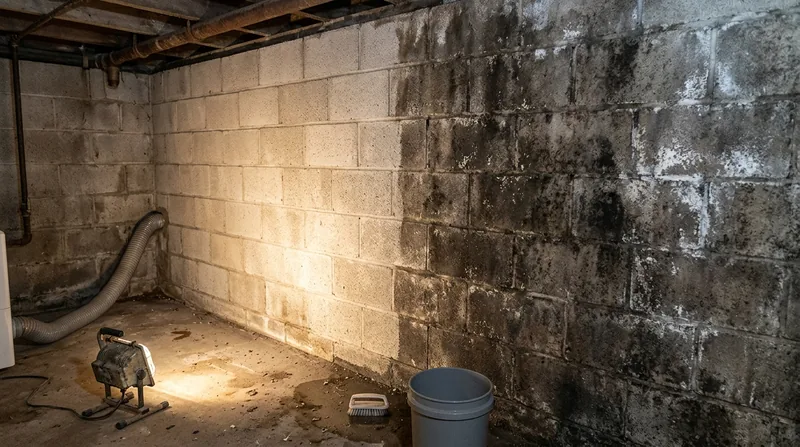




Basement Mold Remediation in Coram starts with a simple fact: mold in a Long Island basement is a moisture problem wearing a disguise. Coram sits in the middle of Suffolk County, between the Harbor Hill moraine to the north and the flat outwash plain that drains toward the South Shore bays. That position gives us sandy glacial soils with denser layers underneath that trap water, and block foundations on 1950s to 1970s Capes and ranches that have been wicking groundwater for decades. When a nor'easter stalls or a summer cloudburst dumps three inches in an hour, that water finds the footing, climbs the block cores, and the musty smell shows up two days later. We treat the mold and we fix the moisture path that feeds it, because remediation without drainage work is a repeat customer plan. Start with a free basement inspection and we will tell you which problem you actually have.
Why Basement Mold Growth Is a Coram Problem, Not a Cleaning Problem
Coram's building stock works against dry basements. The older Capes and hi-ranches on block foundations have mortar joints that absorb water and hollow cores that channel it upward. The 1980s and 2000s Colonials with poured-concrete basements are tighter, but they sit on the same sandy glacial soil with dense layers that perch the water table after heavy rain. Add humid Long Island summers with dew points in the seventies and a dehumidifier running flat out, and you have the two conditions mold needs: moisture and organic dust on framing, drywall, and stored belongings.
- Block foundation walls wick groundwater up through the cores and show efflorescence or white powder at the base.
- Hairline foundation cracks seep after rain and keep the wall cavity damp for weeks.
- Sump pump failures during nor'easters leave standing water that soaks drywall and framing within hours.
- Poor grading and short downspouts dump roof water against the foundation instead of carrying it away.
- Unsealed rim joists and humid summer air condense on cool basement surfaces and feed surface mold.
Each of those has a fix, and none of them is a bleach spray on the joists.
Key info: In Selden and Centereach we routinely find mold on the lower two feet of block walls while the floor stays dry. That pattern points to wall seepage and wicking, not a high water table, and it changes the repair plan completely.
For official guidance on moisture and mold in buildings, the EPA mold resources are a useful plain-language reference for homeowners.
How We Run Basement Mold Remediation in Coram, Step by Step
We do not fog a basement and hand you a bill. The order matters: find the moisture source, stop it, dry the structure, then remove and treat the mold. If we skip to the last step, the growth comes back before the next rain. Here is how a typical job runs in a Coram split-level or a Medford Colonial.
- We walk the basement and the exterior grade, checking wall bases, rim joists, window wells, and the sump basin for the moisture signature.
- We take moisture readings on framing and drywall and map the affected area so the scope is based on numbers, not smell.
- We set up containment with plastic sheeting and negative air pressure so spores do not travel into the living space above.
- We remove porous materials that cannot be cleaned, such as soaked drywall and insulation, and bag them for disposal.
- We HEPA-vacuum and treat structural surfaces with an antimicrobial product rated for the material.
- We correct the moisture path with basement wall sealing, crack injection, drainage, or dehumidification as the readings dictate.
- We verify dryness with a final moisture check and leave you a written summary of what was done and what to watch.
That sequence is why the musty smell diagnostics come first in every estimate.
Key info: A finished basement in Miller Place had mold behind the baseboard on one wall and a dry floor. The cause was a failed downspout leader dumping water at the corner plus a hairline crack below grade. We remediated the wall, injected the crack, and extended the discharge line. No drainage system needed.
Remediation and Moisture Control Methods We Use
Not every mold job in Coram calls for the same tools. Surface mold on a damp wall is a different animal from mold behind a finished wall fed by hydrostatic pressure. The table below shows how we match the method to the finding.
| Approach | Description | Best for |
|---|---|---|
| Containment and HEPA remediation | Sealed work area, negative air pressure, HEPA vacuuming, and antimicrobial treatment of structural surfaces. | Surface mold on joists, framing, and block walls where materials can be saved. |
| Material removal and rebuild prep | Cutting out soaked drywall, insulation, and trim, bagging debris, and prepping the wall for repair. | Finished basements in Ridge and Manorville where drywall has been wet more than 48 hours. |
| Moisture source correction | Crack injection, wall sealing, grading correction, downspout extensions, and window well drainage fixes. | Recurring mold tied to wall seepage, efflorescence, or water after rain. |
| Drainage and dehumidification | Interior perimeter drain, sump and discharge work, and sized dehumidification for humid summers. | Hydrostatic pressure, high water table, or chronic summer humidity in a sealed basement. |
| Vapor control on walls and floors | Dimple board and vapor barrier systems that keep wall and floor moisture out of the interior air. | Damp walls and floors that stay humid even after the visible mold is gone. |
We recommend the least invasive method that actually solves the moisture problem, and we say so when a simple crack seal is enough.
Basement Mold Remediation Cost in Coram: What to Expect
Most residential remediation work in Coram starts around $1,500, and that figure covers a defined scope: containment, HEPA vacuuming, antimicrobial treatment of the affected area, and a written moisture report. The number moves with the size of the affected area, whether finished materials have to come out, how many rooms are involved, and whether the moisture fix requires drainage work or just sealing and grading. A single damp wall in a Port Jefferson Station cottage is a different job from a finished basement in Mount Sinai with mold behind three walls.
We give you the remediation scope and the moisture correction scope as separate line items so you can see what each one costs. If the real problem is hydrostatic pressure, we will tell you plainly that a interior drain tile system is the better answer than repeated cleanings. Get two or three estimates and compare the scope, not just the bottom line. Our full pricing overview breaks down the ranges.
What to Check When Hiring Basement Mold Remediation Near Me in Coram
Mold work attracts contractors who own a sprayer and a truck. A few checks separate the specialists from the rest, and they cost you nothing but a phone call. Ask each one the same questions and compare the answers side by side.
- Confirm the company carries liability insurance and workers' compensation, and ask for a certificate before work starts.
- Get two or three written estimates that list containment, removal, treatment, and moisture correction as separate lines.
- Ask for local references from Coram, Selden, or Centereach jobs and call at least one of them.
- Ask whether the work triggers a building department permit, since structural repair and drainage changes often do, and rules vary by jurisdiction.
- Check HOA rules for townhouse communities before any exterior drainage or discharge line changes.
- Confirm the contractor treats the moisture source, not just the visible mold, and puts the plan in writing.
If a contractor cannot explain why the mold grew, keep looking. Reach us through the contact page when you are ready to compare.
Basement Mold Remediation in Coram: Pricing Guide
| Service | Price | Details |
|---|---|---|
| Single wall or small area remediation | Starting at $1,500 | Containment, HEPA vacuuming, antimicrobial treatment and moisture report for one affected wall area |
| Multi-wall or finished basement remediation | Starting at $3,200 | Includes removal of soaked drywall and insulation, treatment, and rebuild prep across several rooms |
| Remediation plus moisture source correction | On estimate | Scope depends on whether crack injection, wall sealing, drainage or grading work is needed |
| Travel | Included | in Coram and surrounding Suffolk County towns, no separate call-out or mileage fee |
| Estimate | Free | Response within 24h at (631) 830-0164, no obligation to book |
Indicative pricing, the exact cost depends on square footage, finish, and site access. Free personalized estimate within 24h at (631) 830-0164.


