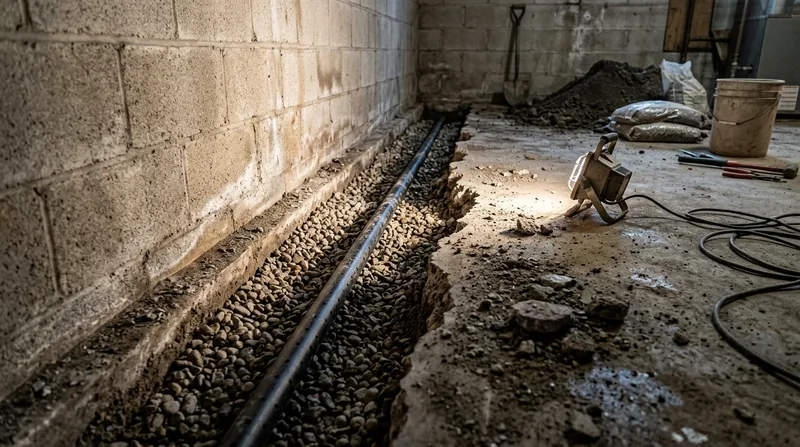




Central Coram sits on sandy glacial outwash with denser clay layers underneath, so when a nor'easter or a summer cloudburst dumps two inches in an hour, water perches above those layers and pushes hard against basement slabs and block footings. The 1950s to 1970s Capes, ranches, and hi-ranches on block basements along the Route 112 corridor were never built with an interior perimeter drain, and many original footing drains have long since silted shut. An Interior Drain Tile System in Coram captures that water at the lowest point inside the foundation, channels it to a sump basin, and pumps it out before it reaches your floor. We install the system under the slab edge, not on top of it, so you keep full ceiling height and finished space. If you are mopping up after every heavy storm, this is the proven year-round fix for Suffolk County basements. Learn more about our full basement waterproofing approach before you decide.
Why Coram Basements Take Water and Why Drain Tile Solves It
Coram is not the North Shore moraine and not the open South Shore outwash. It sits in the transition, where sandy soils drain fast until they hit a denser layer, and then the water table rises quickly after a storm. Block basements from the 1960s were laid on mortar joints that wick moisture, and the original weeping tile at the footing is usually crushed, root-filled, or clogged with silt by now. Hydrostatic pressure, not a single visible crack, is what pushes water through the cove joint where the wall meets the floor.
- Water seeps through the floor-wall joint after every storm because the footing drain no longer carries it away.
- Efflorescence (the white salt bloom) shows up on block walls as moisture migrates through the mortar.
- The basement smells musty by July because damp block holds moisture long after the rain stops.
- A sump pump runs constantly or short-cycles because it is handling water the footing drain should have moved.
When those symptoms show up together, the fix is drainage at the footing, not another coat of sealer on the wall.
Key info: After the August 2014 Islip cloudburst, we pulled wet carpet from finished basements in Coram, Selden, and Centereach where the footing drain had been dead for years. Every one of those homes needed an interior perimeter drain, not a crack patch.
For official guidance on what work triggers a permit in the Town of Brookhaven, check the Town of Brookhaven building department before any structural or drainage alteration begins.
How We Install an Interior Drain Tile System in Coram
We start with a free basement inspection to confirm the water is coming from below the slab and not from a failed downspout or a window well. Then we lay out the perimeter, protect the finished space, and cut a channel along the inside face of the footing. The work is dusty and loud for a day or two, but the sequence is straightforward and we keep the site walkable each evening.
- We break and remove a 12 to 16 inch strip of slab along the perimeter wall and haul the concrete out.
- We dig down to the footing and clean out the old drain tile and any silt or root mass in the trench.
- We set a new perforated drain tile in washed stone, wrapped in filter fabric to keep glacial fines out.
- We core the slab for the sump basin at the low corner and set the basin in stone.
- We connect the drain tile to the basin, install the pump and check valve, and run the discharge line outside.
- We pour new concrete over the trench, tie it to the existing slab, and leave the floor clean and level.
Every system we install includes a transferable warranty, and we test the pump and the discharge line before we call the job done.
Key info: On a 1968 ranch off Middle Country Road in Coram, the footing drain was packed solid with sand and oak roots. We ran 110 linear feet of new interior drain tile to a single basin at the low corner, and the basement has stayed dry through every nor'easter since. The pump discharge tied into a dry well, which the town requires to be verified before the line is buried.
If your existing system is failing rather than missing, see our drain tile repair and replacement page for how we diagnose a partial failure before recommending a full perimeter run.
Interior Drain Tile vs Other Approaches: What Fits Which Basement
Not every wet basement needs the same answer. A single settling crack that weeps after rain is a crack repair job. A basement that takes water across the whole floor line after every storm is a drainage job. The table below shows where each approach fits in Coram's housing stock so you can ask better questions when you get estimates.
| Approach | Description | Best for |
|---|---|---|
| Interior perimeter drain tile | New perforated tile set at the footing inside the slab edge, feeding a sump basin and pump. | Block basements with water at the cove joint after storms; finished basements that need year-round protection. |
| Exterior footing drain | Excavation outside to replace the footing drain and apply membrane to the wall. | Homes with open access, failed exterior drain, and no finished interior to protect. |
| Crack injection | Epoxy or polyurethane injected through ports into a single structural or seeping crack. | Isolated vertical cracks with no floor seepage; poured concrete walls in 1980s and 1990s Colonials. |
| Wall sealing and vapor barrier | Surface sealer on block, dimple board, and vapor barrier to control humidity. | Damp walls and musty smell without standing water; supporting work after drainage is fixed. |
| Sump pump upgrade | New primary pump plus battery backup tied to the existing basin. | Homes that already have a basin but lose power during nor'easters. |
We tell homeowners plainly when a $600 injection is enough and when it will not hold, because hydrostatic pressure finds the next joint the day after you patch the first one.
Interior Drain Tile System Cost in Coram: What to Expect
Interior drain tile pricing starts around $50 per linear foot, and that figure includes the slab cut, the trench, new perforated tile, stone, filter fabric, and concrete replacement. A typical 100 to 120 foot perimeter on a Coram ranch lands in a predictable range once we measure the run. The number moves with total linear footage, whether the sump basin and pump are new, how thick the slab is, and whether the discharge line has to be buried to a dry well.
Finished basements cost more to work in because we protect flooring, framing, and stored items during the cut. Basements with a history of standing water may need mold remediation of framing and drywall before the new system goes in. We give you a written scope with the linear footage and the pump model spelled out, so two estimates can be compared line by line. Get two or three estimates and ask each contractor for the linear footage and whether the pump is included. See the full pricing overview for how the line items break down.
Choosing a Waterproofing Contractor Near Me in Coram
Basement waterproofing is a specialty, and the contractor you hire should do this work every week, not once a season. Ask for proof of insurance before anyone cuts your slab, and ask whether the crew is employees or day labor. A dedicated waterproofing specialist will tell you when the problem is a downspout and not the footing, and will put the linear footage and pump model in writing.
- Confirm the contractor carries liability insurance and workers' compensation and can send a certificate.
- Get two or three written estimates with linear footage, pump model, and warranty terms stated.
- Ask for local references from Coram, Selden, or Centereach and call at least two of them.
- Ask who pulls the permit if the discharge line alters drainage or ties into the sanitary connection, since thresholds vary by jurisdiction.
- Check whether your subdivision or townhouse community has HOA rules covering exterior discharge and dry well placement.
We are a Basement Health Association member, and we hand you the insurance certificate and the warranty terms before the first cut. Reach out through our contact page to schedule a free inspection and get a written scope for your basement.
Interior Drain Tile System in Coram: Pricing Guide
| Service | Price | Details |
|---|---|---|
| Interior perimeter drain tile | Starting at $50/linear ft | Includes slab cut, trench to footing, perforated tile, washed stone, filter fabric, and concrete replacement. |
| Drain tile with new sump basin and pump | Starting at $2,800 | Adds cored basin, primary pump, check valve, and discharge line for a typical 100 to 120 foot perimeter. |
| Finished basement protection and restoration | On estimate | Flooring protection, framing and drywall repair, and mold remediation of materials where water has stood. |
| Discharge line to dry well | On estimate | Depends on run length, soil conditions, and town requirements for the dry well location. |
| Free basement inspection | Free | On-site diagnosis of the water source and a written scope, no obligation to book. |
Indicative pricing, the exact cost depends on square footage, finish, and site access. Free personalized estimate within 24h at (631) 830-0164.


